
You’re not unwell exactly. But you’re not firing on all cylinders either.
The tiredness that doesn’t shift after a good night’s sleep. The brain that feels like it’s running through mud by mid-afternoon. The recovery that takes longer than it used to.
A lot of people arrive at Vital360 with some version of that story. And a lot of them find that mild hyperbaric oxygen therapy — something they’d never heard of six months earlier — becomes one of the most useful tools in their wellness routine.
So what actually happens in the chamber, and what do people notice?
How It Works — In Plain English
Your blood carries oxygen around the body using red blood cells. Under normal conditions, those cells are already close to fully loaded — there’s not much spare capacity.
When you breathe inside the AirPod chamber at a slightly elevated pressure (1.35 times normal atmospheric pressure), something different happens. Oxygen dissolves directly into the fluid part of your blood — the plasma — separate from the red blood cells entirely.
That’s the core idea: more oxygen on board, travelling further through the body’s fluids.
One thing that makes the AirPod different is that it also delivers molecular hydrogen into the chamber alongside the oxygen — an antioxidant pairing most hyperbaric chambers don’t include. Many clients tell us it makes the session feel like a more complete reset.
What Clients Tell Us They Notice
1. More Energy Through the Day
If your energy is low and sleep isn’t fixing it, you’re in the most common category of person who walks through our door. Your mitochondria — the tiny structures inside your cells that produce energy — run on oxygen, and a session gives them plenty of it to work with.
For people dealing with that low-grade tiredness that has quietly become their new normal, a lift in everyday energy is the thing clients mention most often after a course of sessions.
2. Feeling Looser and Better Recovered
That heavy, stiff, slow-to-bounce-back feeling — after big training weeks, busy stretches, or just the accumulation of life — is the second most common reason people come in.
Clients regularly tell us that over a course of sessions, things start to settle: less stiffness, less of that constant background soreness, quicker turnaround between gym sessions or games. Oxygen is one of the basic raw materials your body uses to recover, and the chamber simply gives it more to work with.
3. Better Sleep
Sessions in the chamber are deeply relaxing — most people read, listen to something, or simply doze for the duration. But the benefit many clients value most arrives later that night: deeper, more restorative-feeling sleep. “Best sleep in months” is something we hear a lot at the front desk.
4. Clearer Thinking
Brain fog is one of the most common things people mention when they first come in. Losing your train of thought mid-sentence. Reading the same paragraph three times. Feeling mentally flat by early afternoon.
Your brain is the most oxygen-hungry organ in your body — it uses around 20% of everything you breathe in. Many clients describe the change after regular sessions simply: the fog lifts.
Why Mild Pressure?
A fair question: if hospitals use chambers at twice atmospheric pressure or more, what’s the point of a mild one?
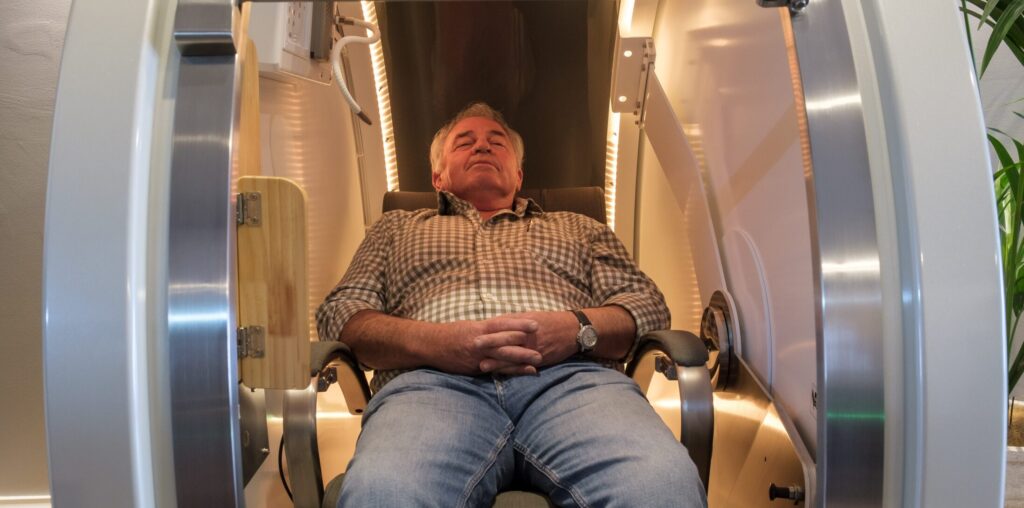
Comfort, accessibility and regular use. The AirPod’s gentle 1.35 ATA is pleasant rather than intense — the pressure feeling in your ears is similar to a plane taking off, and settles in minutes. It’s suitable for regular use as part of an ongoing wellness routine, and the experience itself is the opposite of clinical: you’re in a spacious chamber with clear views out, able to talk to us at any time, free to work, read or sleep.
Is It Right For You?
Mild hyperbaric oxygen therapy isn’t a magic bullet, and it isn’t a replacement for medical care — if you have a health condition, keep working with your doctor. What it is, for many people, is a genuinely useful tool: a relaxing way to give your body more of the raw material it uses to produce energy, recover well, and think clearly.
If you’ve read this far and recognised yourself in any of it, the easiest way to find out is to experience a session. Curious what your first visit involves? We’ve answered the 11 questions clients ask most before their first session.
Ready to try it? Book a single session of mild hyperbaric oxygen therapy in Ballarat at Vital 360 — no packages, no commitment, just see how you feel. Book online or call us on (03) 5303 0753.